
Disciplined Investing in Efficient Markets
When the term “Efficient Markets” is used in investing, it refers to a theory about how market prices are set, such as for stocks and bonds. It’s called a theory because it cannot be proven 100 percent, but there is strong evidence supporting it, and common sense adds further validation. On an average trading day in the global stock market, over $800 billion changes hands between buyers and sellers, each believing they are making the right decision. Virtually all the transactions are executed by highly trained and skilled professionals working for large trading firms, all aiming for a competitive edge. They do this all day; every day.
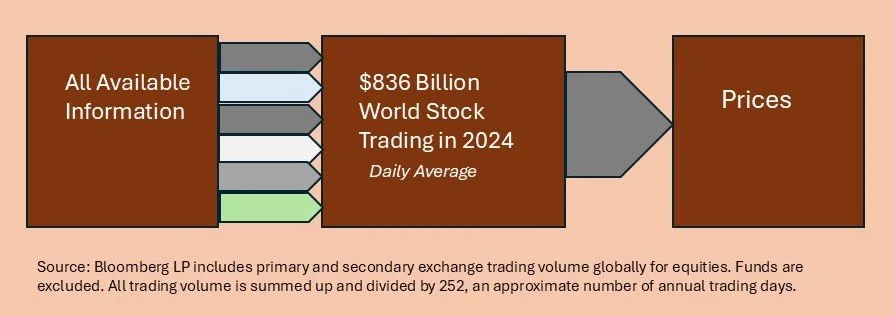
Efficient Market Process
Information is a highly valued commodity in stock price analysis, and all major traders and firms have the resources to access relevant data instantly. The Efficient Market Theory states that the current price of a stock, at this moment, reflects all known information and expectations about that stock - at this moment. The current price is considered the fair value based on supply-and-demand principles between informed buyers and sellers in a global market. It doesn’t claim to be the absolute correct price, because we don’t know what this is. And we don’t know tomorrow’s price because we don’t know how the market will react to new information.
While mispriced securities can happen, there's no proof that anyone can consistently predict short-term price changes; markets are simply too large and efficient. Imagine if someone could do it—everyone and their brother would copy the strategy, and that competitive edge would quickly disappear. The good news for investors is that they don’t need a crystal ball, special skills, or expertise. The most important trait for long-term growth is within their control, but is probably the hardest thing to maintain: discipline. However, discipline is often disliked by transaction-focused Wall Street firms and the financial press because disciplined investors trade less, which lowers trading revenue, but helps investors keep more of their gains.
How can a better understanding of efficient markets help you make smarter investment choices? Well, the next time you hear or read a claim that a specific security is over- or undervalued, remember that they are essentially saying that either they have information that the nearly one-trillion-dollar-a-day market doesn’t have, or the market has simply made a mistake. Neither scenario is likely, and both go against common sense.
If you'd like to learn more about my services or you have questions about your specific situation, please feel free to call me at (925) 484-1671 or email me for a complimentary consultation.
RISKS
Investments involve risks. The investment return and principal value of an investment may fluctuate so that an investor’s shares, when redeemed, may be worth more or less than their original value. Past performance is not a guarantee of future results. Diversification neither assures a profit nor guarantees against loss in a declining market. There is no guarantee that strategies will be successful.
