
Does Your Portfolio Neglect International Stocks?
In a departure from recent years, developed international stocks outperformed their US counterparts. The MSCI World ex USA Index gained 31.9%, outpacing the S&P 500 by the widest margin since 1993 and serving as a reminder of the potential benefits of an internationally diversified portfolio. Emerging markets fared even better than developed markets, with the MSCI Emerging Markets Index rising 33.6%. Global equities, as measured by the MSCI All Country World Index, rose 22.3% for the year.
Approximately half of the global stock opportunities are outside the US.
There are over 50,000 stocks listed on global exchanges, with a collective value of approximately $ 127 trillion. American companies comprise approximately 50% of the total market value. The remaining half includes developed markets outside the US and emerging markets. This presents a significant opportunity set.
Compared to the stock market, the overall global bond market is even larger. In fixed income, the US market accounts for about 41% of global investment-grade securities, a smaller share than the worldwide stock market.
It’s helpful to think of the percentages invested in each region and country as how investors voted with their money after considering many factors, including costs, expected returns, risk, diversification, and their own preferences for holding different investments.
No predictable pattern is found in country returns from period to period.
In any given year, the best-performing countries or asset classes may be in any region of the world, and no evidence suggests that investors can consistently identify in advance which countries will be strong performers. Here is a summary of how the USA has performed worldwide compared to 22 other developed countries from 2005-2024:
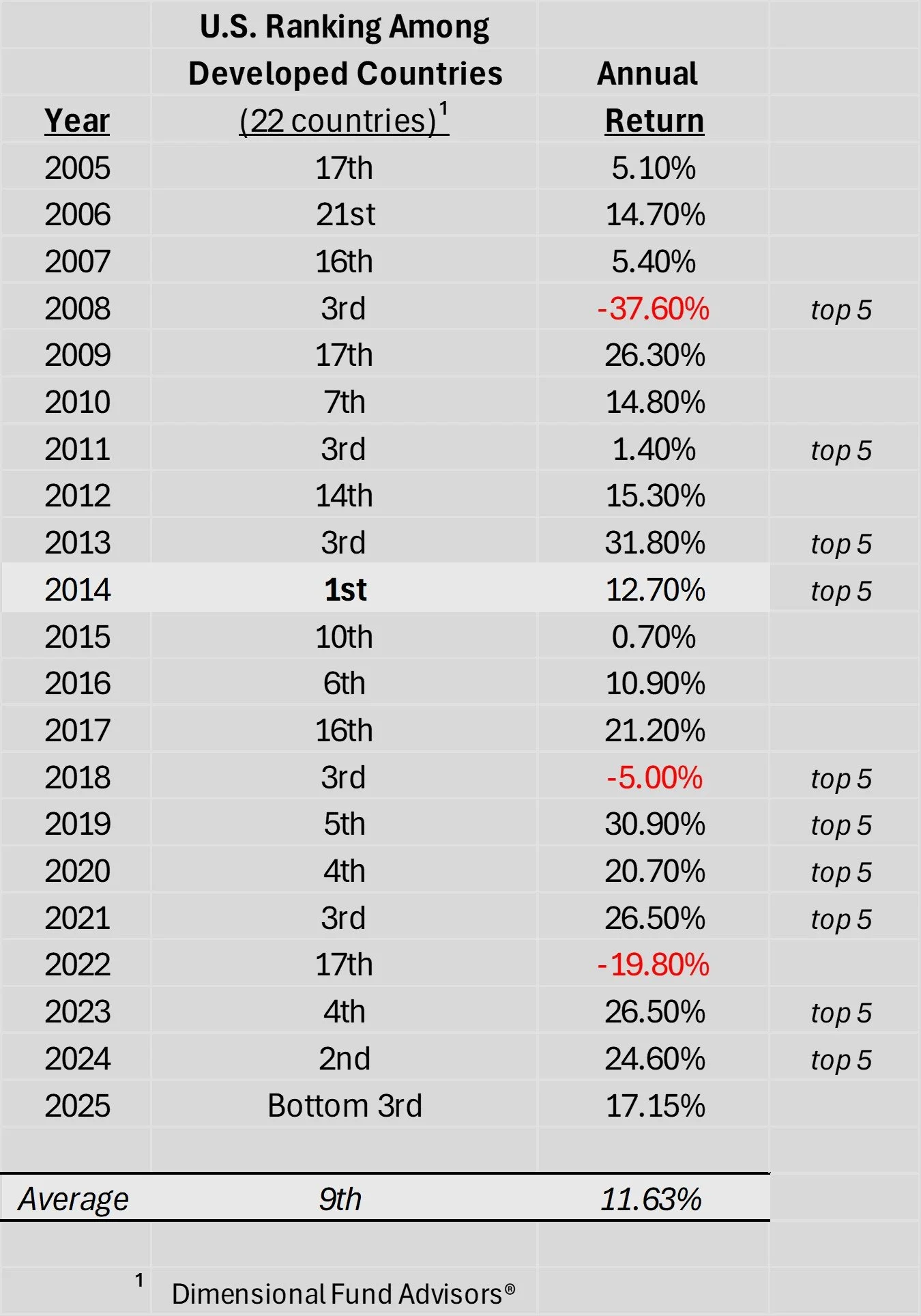
The U.S.A. ranked #1 only once in 2014.
However, in 5 of the last 7, and 10 of the 21 years shown, the U.S.A. has been in the top 5.
Finland has ranked #1 three times since 2005 (see chart).
View Full Chart - Randomness of Global Returns
Investors diversifying outside of their home country can potentially capture these return premiums more reliably. With a well-structured, globally diversified portfolio, investors are better positioned to capture country market performance whenever and wherever it occurs.
For example, over the past 20 years, the US market has been the top-performing developed market only once (2014). Some might find this surprising, given its size. A similar example is China, which has been the top-performing emerging market only once (2006).
The range of country market returns can be extreme. Over the past 20 years, the return differential between the best- and worst-performing countries in developed markets has spanned from a low of 24 percentage points in 2018 to a high of 81 percentage points in 2009. In emerging markets, return differences have ranged from 39 percentage points in 2013 to 159 percentage points in 2005.
The vast differences in annual performance across countries highlight the potential risks of concentrating a large share of assets in any one market.
Investors should be cautious about sacrificing diversification in response to recent strong performance.
There will be periods when a global portfolio delivers higher returns and periods when a country-specific portfolio delivers higher returns. However, identifying these periods in advance can be challenging, and results can change from year to year or decade to decade.
A diversified portfolio will never be the best- or worst-performing compared to its components.
Compared to the performance of the individual components that make up a diversified portfolio, a diversified portfolio will never be the best- or worst-performing during a given period. This is the fundamental point of diversification: to reduce the more extreme returns and increase the reliability of outcomes, especially over long time frames.
A systematic approach to capturing higher expected returns works in both developed and emerging markets.
The Risk Factors Are The Same For US and Non-US Stock Performance
The size (small-cap vs. large-cap) and value (cheap vs. expensive stocks) are widely recognized as fundamental, persistent risk factors that help explain stock returns, alongside the overall market factor. This correlation is not unique to American markets; higher expected returns are well-documented worldwide, in both developed and emerging markets.
Feel free to call me (925) 484-1671 or email me to take advantage of a no-charge consultation. Whether you have questions about my services, your situation, or anything related, I would be happy to assist.
Investments involve risks. The investment return and principal value of an investment may fluctuate so that an investor’s shares, when redeemed, may be worth more or less than their original value. Past performance is not a guarantee of future results. Diversification neither assures a profit nor guarantees against loss in a declining market. There is no guarantee that strategies will be successful.
